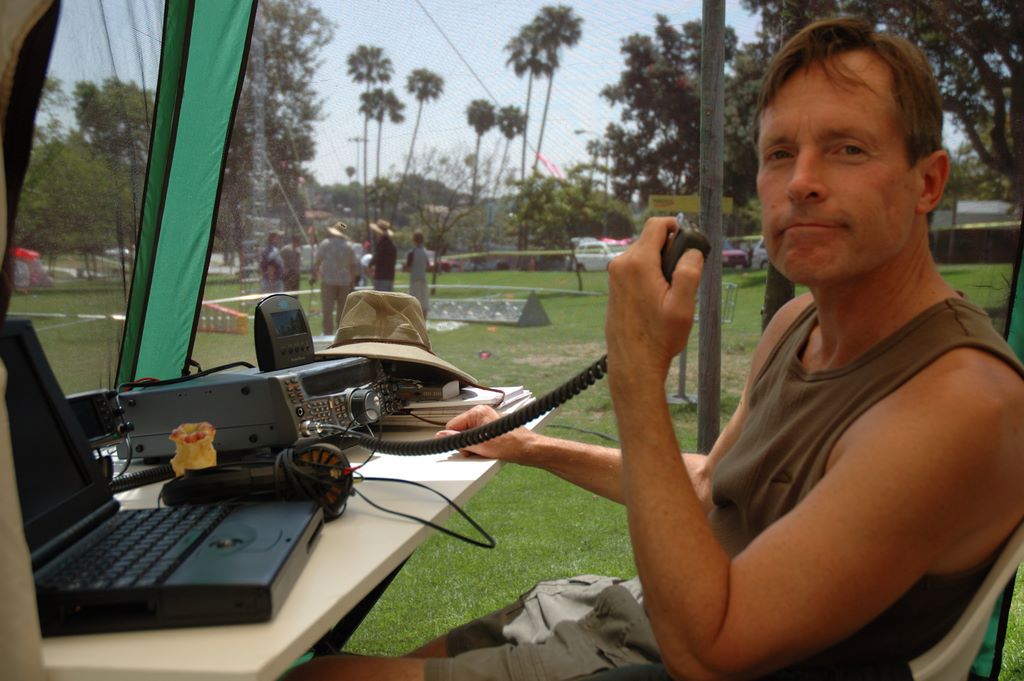
How I Got Started in Amateur Radio
|
By Jim Harrison K6OUE
Like a lot of hams, my father was a ham. But I didn’t get my license until 1995 when I was 42!
When I was little my dad was practically always in his "shack" which was a bench in the garage. I loved playing with all of his junk, electronic parts and pieces and WWII military surplus with big knobs to turn and switches to play with, and gazing into the innards of vacuum tubes. He would be listening to strange noises coming out of the radio and speaking strange things into the microphone, like "king six oboe uncle easy." I thought that maybe I had an uncle named Easy somewhere that I hadn’t met. My father had apparently gotten interested in radios while he was a pilot for the Navy during the war. He had no formal training in electronics, he was a biologist and taught in the agriculture department at Fresno State College. But somehow he figured out how to modify these surplus things into ham gear, and to build his own antennas. When I got older he gave me a little Hallicrafters SX-38 short wave receiver that I kept by my bed and would listen to at night after the lights were turned off. And we built lots of Heathkits together, I loved the smell of melting solder. But he never encouraged me to get a ham license. A few times I would start reading the ARRL Handbook. It starts with resistors and E = IR, that I could understand. But as soon as it got to capacitors and inductors and complex math I was lost, being only in elementary or junior high school. I was also painfully shy as a child and would have been terrified to speak to a stranger over the radio. And none of my friends were amateurs. But it was always in the back of my mind as something to do some day.
However, this exposure to radio and electronics was one of the major influences that got me into the electronics engineering profession. Because radios seemed so mysterious and it seemed like magic that you could speak to someone on the other side of the world instantaneously, I was determined to some day learn how a radio worked. When I started college I had no idea what to major in, but I took math and electronics classes just so I could learn how a radio worked, eventually getting an electrical engineering degree.
Then the no-code Technician license was announced. This suddenly made getting an amateur radio license look so much more feasible. This allows people to get on the air right away with a handheld and see if they like ham radio before putting all the effort into CW and HF. I started going to the TRW Amateur Radio Club meetings. And three of my friends and my brother all decided to get our licenses at the same time. I think having friends doing it at the same time is a great motivating factor. When I got my license, KE6YVM, I was so proud. I wished I could show my dad, but he had already passed away. Having friends who were also new hams was great too because it gave us someone to talk to on the air. I was still afraid to talk to "real hams." But it was great too having the W6TRW 2m repeater to talk on. Everyone on that repeater was so nice and welcoming of new hams. In fact the real breakthrough for me was the W6TRW weekly net, which is no longer on. Checking in to that net and talking a little bit knowing that all those other people were listening really boosted my confidence, not only in ham radio but in all other public speaking situations!
Not long after, the vanity call sign program was started. The first phase of it only allowed people to get the call signs of deceased family members or call signs that they had previously held, if, of course, they were available. I anxiously searched around to see if anyone had picked up K6OUE, my dad’s call sign and no one had. So I applied and got my dad’s old call sign on the air again. He must have gotten it in the mid 1950’s, so sometimes on the air people will mistake me for an old-timer. I felt self-conscious about having this call sign and not knowing CW, so I figured it was time to get my General license. This was before the code requirement had been dropped down to 5 WPM, so I had to learn CW to 13 WPM.
I am sure you have read lots of things about learning CW. I found that it just requires practice. It is a lot like learning a foreign language. You have to keep practicing it, and if you don’t use it you lose it. Some say that if you are musically inclined that CW is easier. I think I am a pretty good musician, but it doesn’t seem to help me with code. I find it a little difficult, but if you really want to do it you can. The way I learned it was with tapes. I bought the 5 WPM tapes from Radio Shack and listened to them in the car every day to and from work. You have to do it every day, once a week just won’t cut it. I also used the computer programs that generate random letters and recorded those on tapes to listen to in the car, because I started to memorize the store bought tapes. When I took the 5 WPM test, I got 100%. For 13 WPM, I listened to a set of tapes that are in the W6TRW shack library, Gordon West’s Complete General Course, again listening in the car every day and pretending to write the characters with my finger on my leg or the car seat. I have to admit that I barely passed the 13 WPM test. I have since only used CW a few times, a couple times on satellites because the signal was so weak, and a few times to get DXpeditions that were only doing CW on a particular band. I would like to do more CW but I don’t have the time for it these days with two little kids at home, so I am starting to forget it. Maybe when I retire.
To go to Advanced required only a written test so I did that soon after. I could now go to Extra class with just a written test since they dropped the code requirement. But I have to admit that I kind of enjoy having the Advanced license since they don’t give them out anymore, and if you have an Advanced license it proves that you passed the 13 WPM test.
Anyway, if you want to get a ham license, you can do it. It just takes some determination and persistence. It has helped me to realize that I can do just about anything I want to do. And the speaking skills have been very valuable. I now find myself striking up conversations with strangers everywhere, not just on the radio. You can meet some interesting people that way!
